How AIDS Ends by San Francisco AIDS Foundation
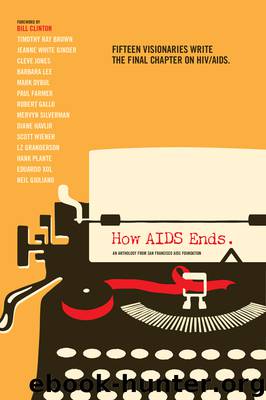
Author:San Francisco AIDS Foundation
Language: eng
Format: epub
Tags: HIV, AIDS, anthology, medicine, cure, epidemic
Publisher: BookBaby
Published: 2012-11-19T16:00:00+00:00
Lessons from History
By Dr. Robert Gallo
Robert Gallo, MD, and his co-workers co-discovered HIV as the cause of AIDS in 1984 and developed the first HIV blood test. His 1996 discovery that chemokines, chemicals produced by the immune system, can block HIV and halt progression to AIDS was a major scientific breakthrough in HIV treatment. Prior to the AIDS epidemic, Dr. Gallo was the first to identify a human retrovirus and the only known human leukemia virus, HTLV-1, one of few viruses shown to cause cancer in humans. He and his co-workers also discovered the human T-cell growth factor interleukin-2 (IL-2), one of the first cytokines, widely used by immunologists and essential in the laboratory culture growth of T cells for isolating retroviruses, including HIV. Dr. Gallo founded and directs the Institute of Human Virology, which harnesses multidisciplinary research, education, and clinical programs for the discovery of diagnostics and therapeutics for chronic and deadly viral and immune disorders. Most recently, he co-founded the Global Virus Network.
Sometimes it’s not clear where inspiration comes from, but for me, the impetus behind my career in medical science isn’t difficult to identify.
I was 12 or 13 years old when my younger sister was diagnosed with leukemia. Her illness brought me into contact with rationalists, scientists, pathologists—types of people I had never fully encountered before—and it impressed me at my young age. I also met doctors where she was hospitalized at what is now the Dana-Farber Cancer Institute; my family became friends with the late Dr. Sidney Farber. I saw medical researchers at work for the first time, and I understood the general goal of what they were trying to do—that is, to take things from guessing toward greater certainty. It must have had a very long-lasting impact.
Even before then, I was exposed to scientific reasoning and concepts. Although my father earned college credits by correspondence course, he became an expert metallurgist and crowded the house with his journals. He was a tremendous worker and student; he did experimental metallurgy, and his work was actually used by the government. He was even sent to teach in South America when he was a young man.
Later, while my parents stayed by my sister’s side at that hospital in Boston, I lived for a time with one of my mother’s sisters, who had married a zoologist. He took me on vacations with his family and my cousins, and I witnessed my uncle’s insatiable curiosity; we would go to the sea, look under rocks, explore, etc. I think all of these things affected me deeply and influenced my eventual career.
When I came to the National Institutes of Health, I wanted to work on the biology of blood cells—and sure enough, little by little I got into leukemia research. Later I was influenced by a Chinese friend who had trained in two Nobel Prize–winning laboratories, and who eventually became a leading virologist at NIH. We played tennis together, and he urged me to get into virology; leukemia in animals, he explained, was often caused by these crazy viruses called “retroviruses.
Download
This site does not store any files on its server. We only index and link to content provided by other sites. Please contact the content providers to delete copyright contents if any and email us, we'll remove relevant links or contents immediately.
Men In Love by Nancy Friday(5232)
Everything Happens for a Reason by Kate Bowler(4733)
The Immortal Life of Henrietta Lacks by Rebecca Skloot(4574)
Why We Sleep by Matthew Walker(4434)
The Sports Rules Book by Human Kinetics(4379)
Not a Diet Book by James Smith(3410)
The Emperor of All Maladies: A Biography of Cancer by Siddhartha Mukherjee(3146)
Sapiens and Homo Deus by Yuval Noah Harari(3064)
Day by Elie Wiesel(2779)
Angels in America by Tony Kushner(2652)
A Burst of Light by Audre Lorde(2597)
Endless Forms Most Beautiful by Sean B. Carroll(2473)
Hashimoto's Protocol by Izabella Wentz PharmD(2371)
Dirty Genes by Ben Lynch(2313)
Reservoir 13 by Jon McGregor(2300)
Wonder by R J Palacio(2203)
And the Band Played On by Randy Shilts(2197)
The Immune System Recovery Plan by Susan Blum(2057)
Stretching to Stay Young by Jessica Matthews(2036)
